The Quiet Force Behind African Fintech: Inside the Crossfin Playbook
Dean Sparrow and Anton Gaylard on backing founders, surviving the wiGroup crisis, building iKhokha against the banks, and the case for patient capital.
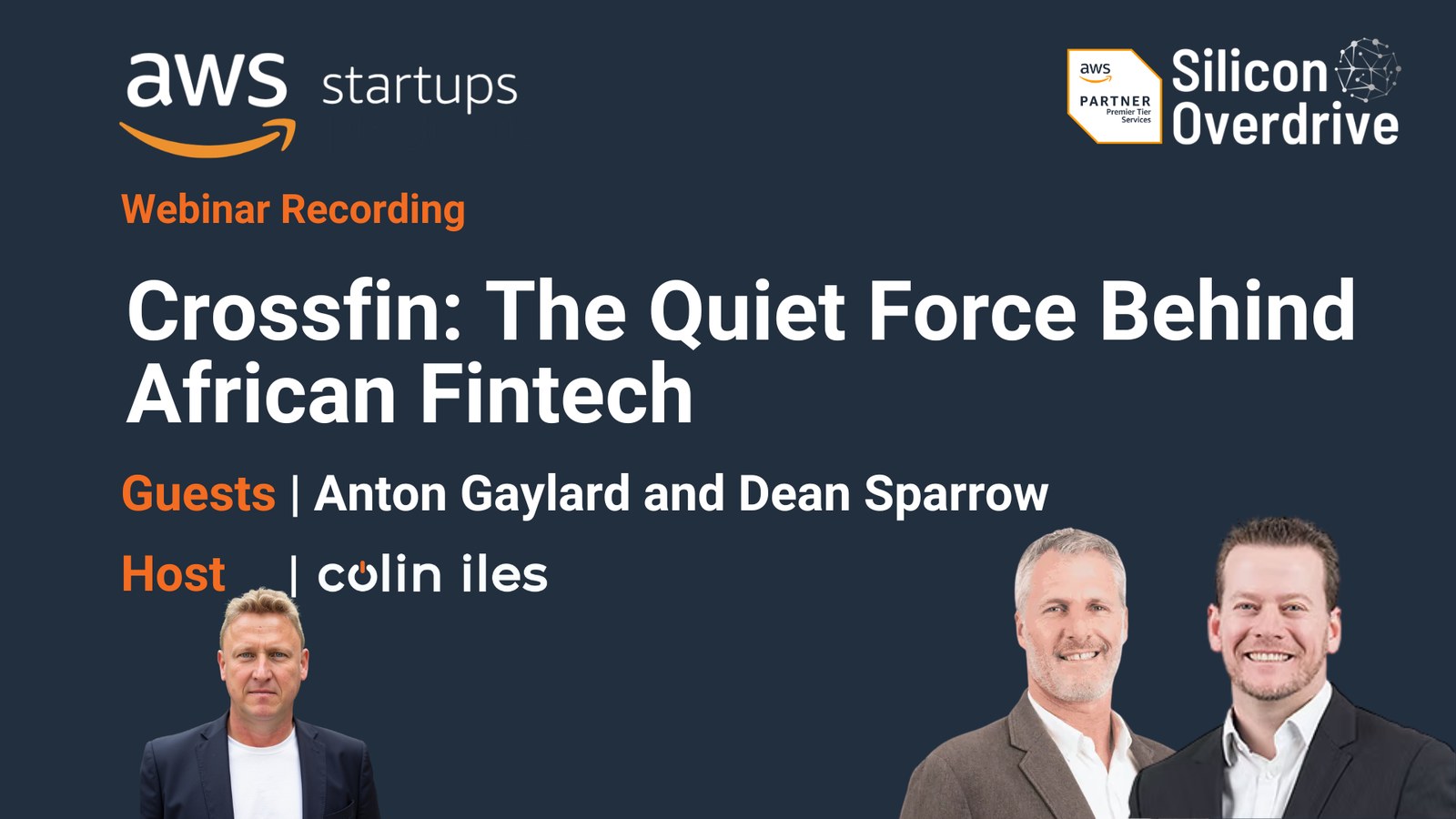 ▶ Watch the full recording
Dean Sparrow and Anton Gaylard are the co-founders of Crossfin, the investment group that has sat behind some of South Africa's best known fintech names: wiGroup, iKhokha, Adumo and Retail Capital among them. Speaking to Colin Iles on the AWS Founders Series, the pair lived up to the session's title, The Quiet Force Behind African Fintech, by opening up a playbook they have deliberately kept out of the headlines. As Sparrow put it, their old UCS Group days earned the internal nickname "undercover computer services", and that instinct for building by word of mouth rather than billboards has flowed through everything since.
| In one line | Crossfin co-founders Dean Sparrow and Anton Gaylard open the playbook behind wiGroup, iKhokha, Adumo and Retail Capital. |
| Key number | wiGroup was held for north of 12 years and iKhokha for north of 13, against a typical 5 to 7 year private equity clock. |
| Who should read this | Fintech founders raising capital, and investors backing early-stage African companies. |
| Bottom line | Back the jockey, stay transparent when things break, and give African fintech more patient capital than the standard fund model allows. |
| Read time | 8 min |
From retail software operators to fintech investors
Neither founder came from private equity. Sparrow and Gaylard met at the UCS Group, a small cap JSE listed business positioned as the one stop shop for retailers' IT requirements. Gaylard joined the executive team in 2008 to head up value added services: payments in store, loyalty, gift cards, multi-channel payments and the e-commerce wave that was starting to pull logistics and distribution into the picture. Sparrow, meanwhile, had moved from the CFO seat into the deputy CEO role.
The credit crisis forced the pivot. As a small cap, UCS struggled to unlock value for shareholders, sold off 75 per cent of the group, and delisted at the back end of 2011. The vehicle was renamed Capital Eye Investments, backed by institutions including RMB alongside high net worth individuals, with a mandate to invest beyond retail. The logical thread they followed was decentralised engagement with the end consumer, which pointed straight at financial services. Market appetite for what was now being called fintech met a new generation of businesses looking for backing, and by 2017 that combination had become Crossfin, focused exclusively on the sector.
Backing the jockey, not the idea
The philosophy that recurs across the portfolio is backing founders rather than products. The archetype is Bevan Ducasse, who arrived in his early twenties with a mobile payments concept that, in Gaylard's words, did work: the market simply was not ready for it. Crossfin stuck with him anyway, and wiGroup became one of their longest and most formative relationships.
What they look for is specific. Founders with values and culture close to their own, who can lead, motivate and build teams, run lean businesses with a full handle on the metrics, and stay honest when things get hard. Above all, focus. "I'm kind of visionary, I see so many ideas and opportunities all the time," Gaylard admitted, describing how he knocks on founders' doors with suggestions only to be politely told what the next three months already hold. "I very often get put in my place," he said, and he counts that discipline as a strength, not a snub.
Building iKhokha against the banks
The iKhokha story shows the ecosystem logic at work. In 2012 Matt Puttman and his business partner Ramsey arrived with a strong referral from Ducasse and a product that was working in the United States but could not simply be copied: South Africa required chip and PIN, in the earliest days of mPOS. Matt's father Clive, an engineer, could build the device. Crossfin could supply the rest: wiGroup built the mobile app, and the group's Innervation business and Destiny payments switch handled integration into the banks.
By the time the device was industrialised and EMV certified, they had been pipped at the post by two renowned brands, Nedbank with its PocketPOS offering and Absa launching the Pebble. What gave them the confidence to continue was the go to market gap. iKhokha's digital first proposition promised a self service merchant a device within roughly 24 to 48 hours, while the bank processes behind the incumbents took around six weeks to onboard and sign off the same merchant. Solving that conundrum, from around 2014, became the wedge.
Supported by
Silicon Overdrive
Silicon Overdrive Founders Series

An AWS Premier Partner running cloud infrastructure for South African businesses: architecting, migration, security and compliance, monitoring and cost optimisation. They also invoice in rand and can arrange proof-of-concept credits.
See their AWS services→When it nearly fell apart: the wiGroup crisis
The most sobering passage of the conversation covered the period around 2017 when wiGroup, by then well represented across South African retail and hospitality, raised capital to expand into new markets. With Ducasse on a plane building abroad, the finance function back home misrepresented the numbers for 12 to 18 months. The result was a hole of some R60 to R70 million in the economics of the business, and daily war room sessions for the better part of four to six weeks as Crossfin and a co-investor injected capital, right sized the cost base and restructured.
A forensic investigation followed, extending to lifestyle audits on the two founders, neither of whom was implicated. What saved the relationships, both with customers and with institutional investors, was radical transparency: Ducasse approached every customer individually and talked them through the reality. Gaylard distilled the house rule that came out of it: "Good news travels fast. But the more important one is bad news travels faster. Because we can help you if we know that there's a problem."
Retail Capital and the discipline of deference
Retail Capital came through a relationship with Karl Westvig, who had built and exited RCS before pouring his energy into merchant cash advances. The thesis Westvig put to Crossfin was distribution: iKhokha owned merchant relationships, and a digital interaction between iKhokha and Retail Capital could solve the manual sales model. Crossfin invested through an SPV with Apis Partners out of the UK, with Apis and Crossfin jointly holding about a third, Futuregrowth about a third, and management the balance.
When COVID cut transactional activity, and therefore book collections, to roughly 10 per cent of normal levels, Sparrow was candid that Crossfin were not the credit experts in the room and did not pretend to be. They deferred to the specialists on liquidity and debt providers, kept every stakeholder informed, and avoided knee jerk reactions. The business was exited in December 2022, with the first tranche of the exit going to what is now GoTyme.
What do founders pitching Crossfin get wrong?
Gaylard, who sees hundreds of approaches a year, drew a line between a good business and an investable one. Founders fail to research the match with an investor's mandate, vertical, geography and quantum. They rush to raise, or raise too much too early, then get caught on the back foot. The ones who impress spend sweat rather than cash equity to prove the points, arrive with the metrics known, and can say exactly what the money is for and what growth it converts into. Sparrow added the valuation trap: founders fixate on the market's perception of value, raise at numbers the business cannot justify, and end up sitting behind layers of complicated instruments, building good businesses whose fruits they never get to enjoy.
Upcoming Virtual Event
From Talk Radio To Tech Hub Founder
Monday, 9 November 2026
With Kieno Kammies, Innovation City Cape Town
RegisterColin Iles Media
Invested in webinars but disappointed with the conversions?
We build rooms that senior decision makers actually show up to. You get the pipeline.
Book a strategy callCurated audiences of CIOs, CTOs, and founders across Africa
When should a founder raise, and how are early valuations really set?
On timing, Gaylard refused to be black and white, but offered one certainty borrowed from an old ditty: the wrong time to raise money is when you need it. Desperation invites bargain hunters and stringent terms. Raise ahead of the curve, in tranches against milestones, and protect equity by answering the deployment questions before taking the cheque.
On valuation, Sparrow walked through the actual mechanics of the early deals. wiGroup was seeded with R4 million, split as R2 million in equity and R2 million on loan so that the founders kept half the business and an absolute vested interest. When regulators effectively killed the original card model within six months, the structure was tweaked rather than torn up, and the business pivoted into vouchers and coupons. The science, he said, is working out what money is required to prove the concept, and comparing against relevant peers in other markets with a discount or premium applied. "And then the horse trading starts."
Which payments problems are still underserved?
Asked by an audience member where a fintech infrastructure founder should look over the next five years, Sparrow pointed to the divide between mobile money and traditional banking across the continent, and the missing mechanism that would let either settle seamlessly at the point of service. Gaylard went to fraud: as the world goes all digital, protecting credentials and transactions is the problem that has to be solved properly. It shows in the current portfolio, from Mercury in the UAE, held through Unity Digital Holdings and partnered with PAPSS on interoperable and sovereign payment schemes across Africa, to MyPinPad, whose soft POS solutions are growing fast in South America as payments move onto mobile devices and toward agentic commerce.
Why do Sparrow and Gaylard want more patient capital?
Perhaps the most honest admission of the session was that Crossfin's celebrated exits were largely consequential rather than designed. Partnering with private equity funds with finite fund lives meant contracting to definitive exit points, and delivering against them. Selling iKhokha, Adumo and Retail Capital to different buyers broke up a network of businesses that, Sparrow argued, could arguably have been far more valuable together over the longer term. Their preference today is patient capital and buy-and-build: wiGroup was held for north of 12 years and iKhokha for north of 13, and in African markets they simply do not see value crystallising inside the traditional five to seven year fund model.
The Backroom
Get conversations with senior leaders delivered to your inbox.