From Paper Loans to AI Banking
Chijioke Dozie on Nigeria's $5bn credit gap, Carbon's 7-minute loans, and how AI is reshaping digital banking in Africa. Full recap and video.
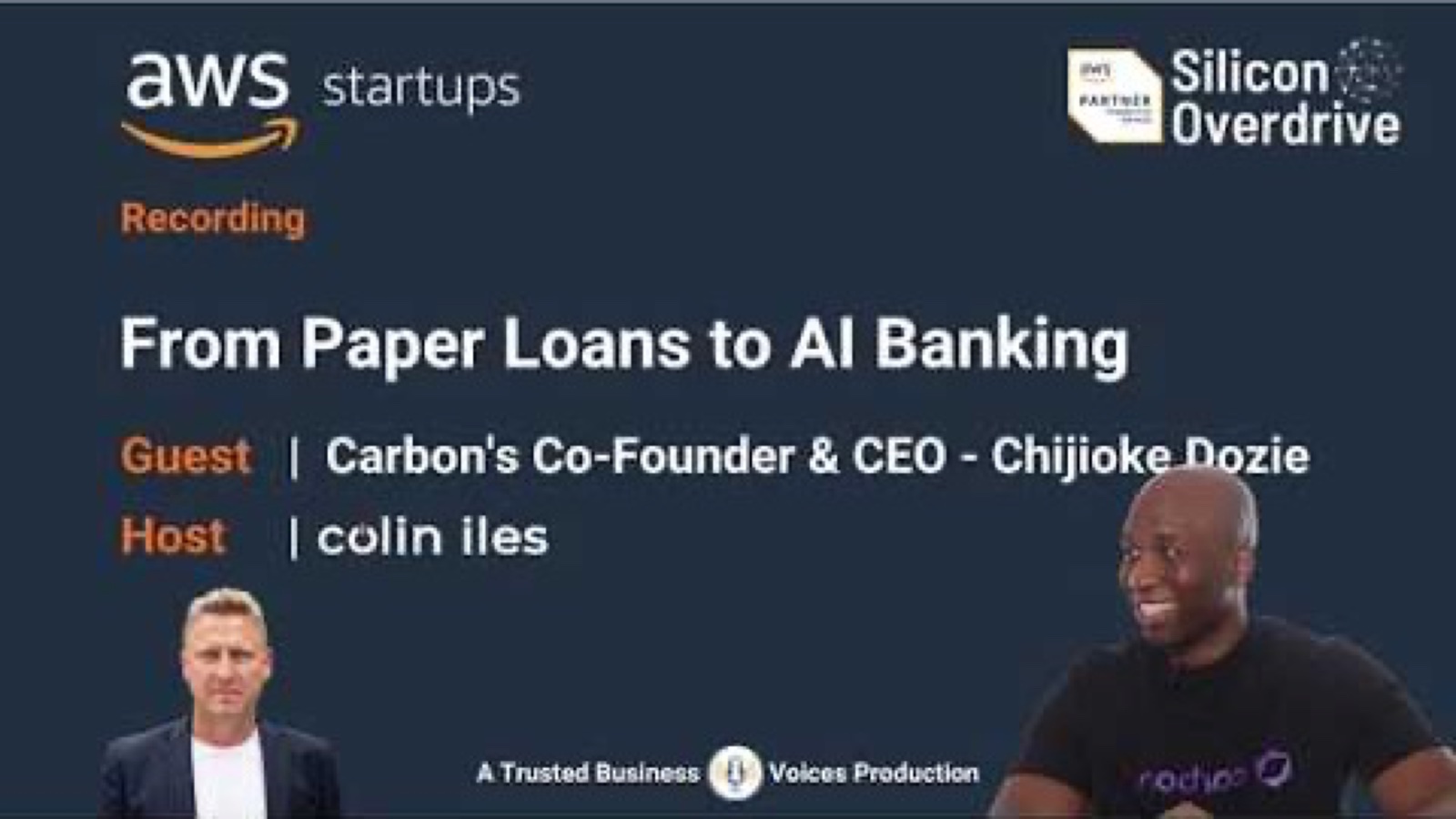 ▶ Watch the full recording
Chijioke Dozie on building Nigeria's credit-led digital bank: the copper mine moment, the 7-minute loan, disciplined funding, and what AI changes next.
- Nigeria did about $5bn of consumer and SME lending in 2024. South Africa, with a quarter of the population, did roughly $500bn.
- Carbon approves consumer loans in about 7 minutes, end to end, on a phone.
- The 2016 digital pivot took Carbon from 20,000 applications a year to 8,000 a day.
- Carbon has served over 5 million customers on roughly $13m of external funding.
- Dozie's one AI fear: a five-person startup replicating Carbon.
Chijioke Dozie built Carbon in a market most bankers wrote off as unservable. In this AWS Founders Series conversation, the co-founder and CEO of the Nigerian credit-led digital bank explains why Nigeria's consumer credit market is a hundred times smaller than South Africa's, how Carbon went from paper application forms to 8,000 loan applications a day, and why his one AI fear is someone rebuilding his company with five people.
The copper mine moment: where the idea for Carbon started
Carbon's origin story begins in a Zambian copper mine, years before the company existed. During his private equity days, Dozie was doing due diligence on a consumer finance business when he watched a miner with a pickaxe sit down at his place of work to fill out a paper loan application. The miner banked with Standard Chartered, but as he put it, the bank would take his money and never lend him any. The branch manager confirmed the logic: too risky, amounts too small to bother with.
Dozie kept meeting the same bias in Nigeria. Company executives insisted their employees had access to loans when only the C-suite did. Bankers told him unsecured consumer lending could never work, then called him privately asking for loans after the meeting. That gap between perception and reality, he argues, is exactly where the opportunity sits: "Invest using data. The data tells me that people are underserved, people want credit, and they will pay back."
Nigeria's $5 billion credit gap: why banks stay on the sidelines
Nigeria has 230 million people to South Africa's 63 million, yet in 2024 South Africa wrote roughly $500 billion in consumer and SME loans against Nigeria's $5 billion. Dozie is clear that the problem is not demand. Nigeria has three functioning credit bureaus, but scores are not widely used and carry little consequence: a bad score does not stop you renting a house, getting a phone plan or landing a job, so there is no incentive to protect it.
Banks respond by lending only to their own vetted customers, which keeps the market frozen. As Dozie puts it, the Bank of Family and Friends is still the number one lender in the country. He is hopeful open banking will change the dynamic by letting customers share their data and forcing banks to compete for strangers, the way an Absa once beat Standard Bank for his own mortgage in South Africa.
This episode was sponsored by
Silicon Overdrive
Silicon Overdrive Founders Series
An AWS Premier Partner running cloud infrastructure for South African businesses: architecting, migration, security and compliance, monitoring and cost optimisation. They also invoice in rand and can arrange proof-of-concept credits.
See their AWS services→Upcoming Virtual Event
From Talk Radio To Tech Hub Founder
Monday, 9 November 2026
With Kieno Kammies, Innovation City Cape Town
RegisterFrom debt collection to 8,000 applications a day
Before lending a single naira, Dozie and his brother spent 2011 running a debt collection business for four banks, and the lesson reshaped their plan: most defaulters wanted to repay but the infrastructure failed them, and banks simply could not serve loans between zero and $15,000 economically. Carbon started lending completely unsecured, with Excel as the operating system and agents carrying paper forms door to door. One-month loans meant repayment data came back fast.
The 2016 pivot to digital changed everything. Nigeria's Bank Verification Number made remote KYC possible, and payment companies like Paystack and Flutterwave let Carbon tokenise debit cards instead of holding signed cheques as collateral. Applications went from about 20,000 in a good year to roughly 8,000 a day. The build was not smooth: the engineering team walked out on the eve of launch, Andela filled the gap, and the founders flew to California for ten days to find data science help, with Lenddo building Carbon's first app for free.
The 7-minute loan: how Carbon underwrites strangers
A new Carbon customer can go from downloading the app to money in their account in about seven minutes, covering onboarding, KYC, credit bureau checks, underwriting and disbursement. SME loans are semi-automated and take 24 to 48 hours. Repeat customers are scored on their transaction history, bill payments and bank statements, with machine learning matching new applicants against the performance of similar past borrowers.
In the early days Carbon deliberately lent to people it probably should not have, because the first job was proving legitimacy: the company's own Facebook page spent three months full of Nigerians calling it a scam.
Raising $13 million, not hundreds: the strategic investor trade-off
Carbon has served over five million customers on roughly $13 million of external funding: a 2014 seed from an angel investor and a Series A from Net1, the South African company now listed on NASDAQ as Lesaka, of about $10 million in equity plus $3 million convertible. A strategic investor focused the board on risk and roll rates while competitors burned marketing money, which Dozie credits for Carbon's discipline: profitable in 2018 and 2019, knocked back by COVID, and now profitable again, with revenue led by interest income rather than fees.
His advice to founders is to delay raising for as long as possible to preserve optionality, and to think hard before taking strategic money early, because a strategic's goal of holding the asset sits in permanent tension with a financial investor's goal of maximising the next round.
AI at Carbon: automation, fraud detection and the five-person competitor
Dozie's only stated fear about AI is that someone will wake up and replicate Carbon with five people. Inside the bank, AI has automated reconciliations and strengthened fraud and AML pattern detection, with a human kept in the loop for key decisions. He is unsentimental about the customer side: people are happy talking to a bot that solves their problem, and the next generation may find bank branches as strange as paper loan forms. The prize, in his view, is freeing humans for bespoke customer problems while AI absorbs the drudgery.
Jump to a section of the interview
All links open the full recording on YouTube.
- What Carbon is and how it positions itself
- Nigeria vs South Africa: the credit numbers
- The seven-minute loan process
- The copper mine story
- Debt collection first: testing the market
- The 2016 digital pivot
- Funding: Net1, Lesaka and strategic investors
- Culture, hybrid work and motivation
- AI in banking
- Why founders should look at Nigeria
Why can't Nigerians just get loans from their banks?
Nigerian banks mostly lend to their own established customers because credit scores carry no real-life consequences, making unsecured lending to strangers look unmanageably risky. Defaulting on a loan in Nigeria does not affect your ability to rent, work or get a phone contract, so the incentive to maintain a clean record is weak, and banks price that uncertainty by not lending at all.
How does Carbon approve a loan in seven minutes?
Carbon runs the entire journey digitally: app download, identity verification against Nigeria's Bank Verification Number, credit bureau checks, machine learning underwriting against similar past borrowers, and disbursement. Repeat customers are scored on transaction and bill payment history inside the platform, plus ingested bank statements.
Is Carbon profitable?
Yes. Carbon was profitable in 2018 and 2019, went through a difficult COVID period when good customers could not pay, and has returned to profitability, with most revenue coming from interest income rather than transaction fees.
The Backroom
Get conversations with senior leaders delivered to your inbox.