Why Kieno Kammies Left Radio at 47 to Build Innovation City
Kieno Kammies on leaving talk radio at 47, building Innovation City Cape Town through COVID, and why founders must find a market in the gap.
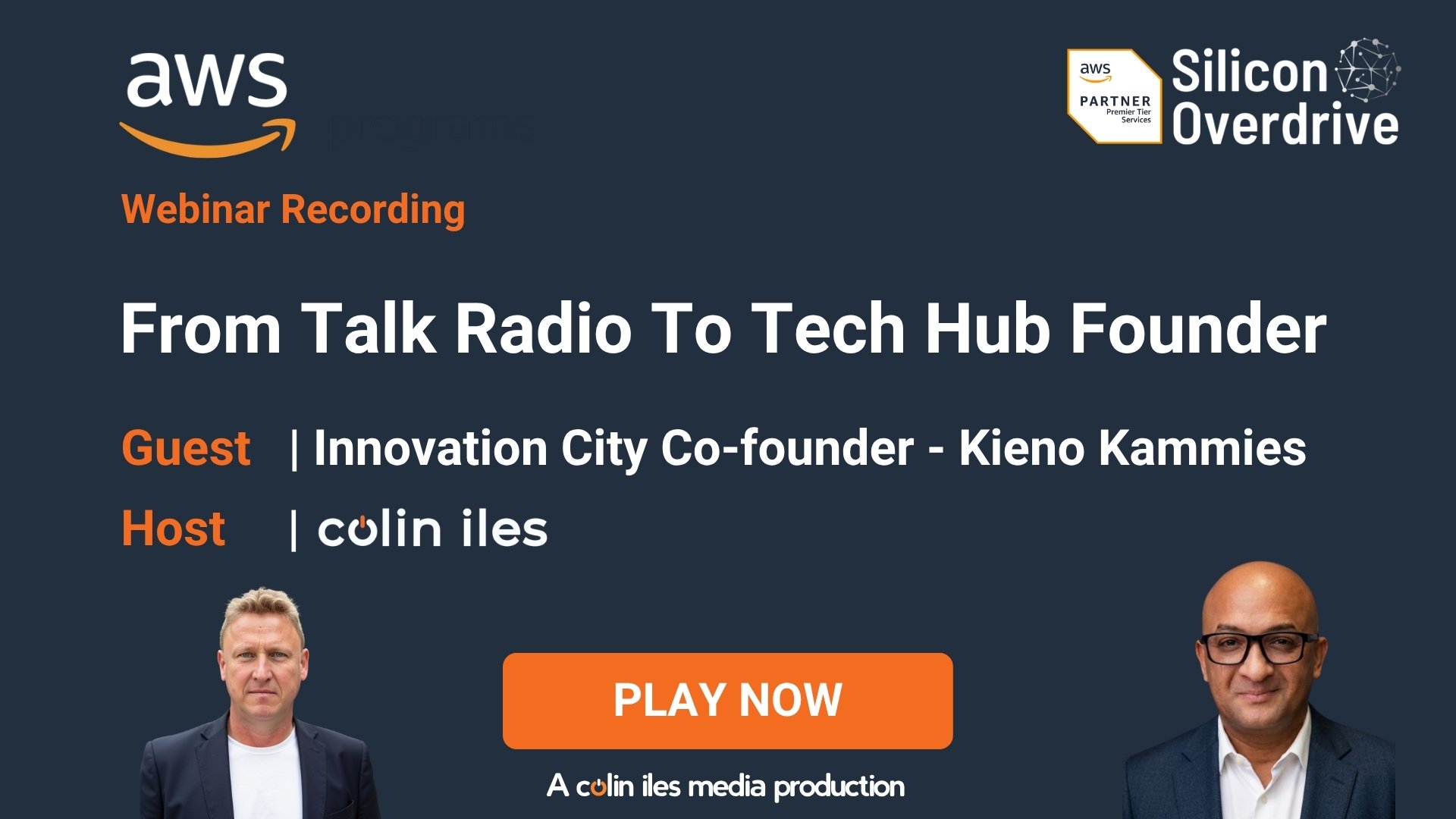 ▶ Watch the full recording
| In one line | After about 30 years on radio, Kieno Kammies co-founded Innovation City Cape Town on the bet that a hub only lasts if its community adds to your bottom line. |
| Who should read this | Founders thinking about making the jump, leaders building culture, and anyone who wants to understand how introductions really create business in South Africa. |
| Key number | About 3,500 square metres, home to 50 to 70 businesses at any given time. |
| Bottom line | Find the market in the gap, get dirt under your boots, know your acceptable loss, and remove whoever poisons the water. |
| Read time | 10 min |
Most people know Kieno Kammies as a voice. About 30 years on radio, the last stretch of it on CapeTalk. I know him as somebody who can tap on a window at MTN and get a senior executive to walk out of a meeting.
Kieno is the co-founder, with Stephan Ekbergh, of Innovation City Cape Town. He is also managing director of CDI Capital and sits on the boards of Business Ireland South Africa and TSiBA. He joined me on the AWS Founders Series on 9 November 2026 to explain how a postman's son from Elsies River ended up there, and what he has learned along the way about networks, culture and finding a market worth serving. The AWS Founders Series is made possible by Silicon Overdrive and Amazon Web Services.
Tinder for business: what Innovation City actually does
Innovation City brings corporates, startups, scale-ups and funders into one building and works at connecting them. Kieno's short version: "we're like Tinder for business, right?"
It started in 2021. COVID had hit Travelstart, Stephan's business, and a lot of people had left, which left a building. Everybody asked the same thing: "why do you want to do this when everybody else is doing it? And why do you want to do it in the midst of COVID?"
They answered it sitting in a boardroom, and the answer had nothing to do with furniture. You can get a good boardroom and great internet at home. "What we needed to do is build community that actually adds to your bottom line."
The tap on the window: how a five-minute introduction works
I have walked around Innovation City and always wondered how they get busy people to give up their time for each other. Kieno answered with a story.
Mark Roden, a major shareholder in Ding.com, arrived from Ireland with a group on his first visit to the continent. His problem was that he "could not get access to a telco that would take them seriously in sub-Saharan Africa." MTN's group function for digital sits in the Innovation City building. So Kieno walked him across the passage, to where Burak Akinci was sitting on a meeting, and tapped on the window.
Burak muted his computer, switched off his camera, popped out and gave Mark five or six minutes. They exchanged details. Kieno says Mark later sold 70% of Ding.com for 320 million euros, and he draws the moral himself: "You can make 320 million euros, you still need to get access to the right people to take your business forward."
Supported by
Silicon Overdrive
Silicon Overdrive Founders Series

An AWS Premier Partner running cloud infrastructure for South African businesses: architecting, migration, security and compliance, monitoring and cost optimisation. They also invoice in rand and can arrange proof-of-concept credits.
See their AWS services→Upcoming Virtual Event
From Talk Radio To Tech Hub Founder
Monday, 9 November 2026
With Kieno Kammies, Innovation City Cape Town
RegisterGrowing your own timber: can the hub run without its connector?
Kieno's black book is the obvious risk in this model, so I asked what happens when he goes on holiday. His answer is "growing your own timber": appointing a community manager with the right temperament and taking her to every meeting.
"You don't necessarily need to know everybody, but you need the right personality." The skill is knowing when to stop. He cannot phone me on Monday with an introduction and then chase me on Wednesday, Thursday and Friday, "Because all you can think is that I want to get something out of you."
Networked networks: how Old Mutual and MTN came through the door
When they launched, Kieno stood at the top of the staircase and asked himself how they were going to fill the place. "We had no business model, no business plan really."
He reminded me, on air, that I had a small hand in what happened next: I knew Iain Williamson, then group CEO of Old Mutual, and Iain came to have a look. Iain pointed them to NEXT176 and Vuyo Mpako. Old Mutual became the first listed company in the building. MTN followed two or three months later. Then Kieno picked up the phone to Zach George at Launch Africa.
He calls this "networked networks", and the point is that the relationships came first. These were people he had shared a glass of wine with over the years, who were now in different positions.
Leaving radio at 47: COVID, high care and "I've got to go"
Walking away from a daily show sounds braver than Kieno makes it. His contract meant he could not work for another radio station for a year and they would have to pay him out, so he knew he had something to fall back on. He is quick to say most people do not.
What pushed him was a calculation and a scare. "Do I want to be over 50 looking for another radio gig?" Then he went into high care with COVID. He cried on CapeTalk the day after he was released, and he could not walk 15 metres. "And I said to my wife, I've got to go."
Rob Paddock phoned about UCT Online High School. A couple of months later Stephan called. "I was lucky," he says, and he means it.
The hard years: an understatement and a half
I asked whether it had been hard. "That's about an understatement and a half." His wife did not know what he was talking about, and his friends told him he would close because everyone else was closing.
The numbers explain why. "It literally costs millions to run a month." He would go to 20 different people and get 20 nos, and be asked why any company with its own offices would want to leave them. "And when we did find the three people who got it, it became a lot easier after that."
I put it to him that this is the moment every founder meets product-market fit, and asked how you get through it emotionally. Grit, I suggested. "And whiskey, amongst other things."
From Elsies River to Reuters: putting your foot in the door
His dad was a postman and his mum worked in a factory. "And they always said to me that where you live and who you are doesn't define where you're going to be."
At 17, bored after matric, he went to a rally around the corner, saw a cameraman and asked if he could look through the viewfinder. The cameraman, Jimmy Matthews, invited him to spend some time at Reuters. For six or seven months he dodged the gangsters to get to Elsies River Station and made coffee in town, asking questions until he was allowed to touch the equipment. When someone did not pitch and they needed sound, they asked if he could do it. "I said, yeah. I lied."
He did the same at the SABC, knocking on the door at Good Hope FM as a cameraman from upstairs. It is the most useful career advice in the hour: "It's not a linear journey, right?"
Hustle, university and a nine-year-old with a 3D printer
Kieno has a view on permanent jobs. "When COVID hit, the people that were hardest hit were the ones with permanent jobs," he says, and being on a year-to-year contract for most of his career prepared him for it. Executives, he argues, need to plan where they want to be tomorrow, today.
He is not against university. "I don't think I want to climb on a plane built by someone who taught themselves on Udemy." But he moved his nine-year-old out of private school, bought a Creality 3D printer, and now his son uses Claude and OpenSCAD to change models, makes products and is about to sell them at a market with his own Yoco machine.
Kieno spends two hours every day on AI, one to learn and one to implement. On the board of TSiBA, the message to management is that they need an F-around-and-find-out budget. "What can you build? What can you do? What have you learnt?"
Building something on AWS, or working out where AI fits? Silicon Overdrive, the sponsors of this series, are the people I'd talk to. Book 30 minutes with Ross Davie.
Find the market in the gap: what the best founders do differently
The line of the session came from Neil Schreuder of ShopriteX. Kieno had found a beautiful place in Bloubergstrand going for a song and phoned Neil for a view. "There might be a gap in the market, but can you find a market in the gap?"
He went looking, could not find one, and walked away. The businesses that last in his building have found it. Smile ID started somewhere, learned the nuance of each market, and has outgrown the space.
Finding it needs what André de Ruyter called dirt under your boots. "I can do Claude right now. It'll pretend to find a market in the gap for me." It cannot look someone in the eye and understand what they would spend money on. And you need to know your acceptable loss: "the trick is you also need to know when to give up."
The no-arsehole policy: culture as a commercial decision
Innovation City has a rule, and Kieno enforces it. "We have a no-arsehole policy, right, literally." His reasoning is practical: "you can't un-arsehole people."
He asks audiences where the best storytelling platform in a business is. It is the kitchen, where people making coffee talk about how they experience the place. Culture, he says, "is what people say about you as a leader when your back is turned."
When an MD shouted at reception, they phoned the man's chairman and said the company could leave in thirty days if he continued. I pushed back that a big organisation cannot work like that. He pointed to about 3,500 square metres with 50 to 70 businesses in it, and almost no issues. "It's more expensive for me, Colin, to keep someone who poisons the water than to offload them."
What South Africa needs next: skills, ecosystems and a coalition of the willing
I compared what we have with the 60 or 70 years Silicon Valley has spent building its cauldron of big business, startups, universities and capital, and said we have some unicorns starting to appear. "Why do we always focus on unicorns?" he asked.
Given two minutes, he asked for three things: re-educate education with future skills, create more ecosystems where people can learn what they don't know, and build a coalition of the willing. His closing advice borrowed from Dr Saras Sarasvathy's effectual thinking, as opposed to five-year strategies: what is your purpose, what is your acceptable loss, what is the bird in the hand, and who is in your network?
"And then that becomes this loop that keeps giving, because you don't do this on your own."
Who to talk to about AWS, cloud and AI: Silicon Overdrive
Silicon Overdrive sponsors the AWS Founders Series alongside Amazon Web Services, and none of these conversations happen without them. It is an AWS Premier Tier Partner that helps South African and African businesses build on AWS, and get more for what they spend than they would going direct.
If you are looking at cloud, AWS or AI, they are the people I would talk to. See what Silicon Overdrive does on AWS, or book 30 minutes with Ross Davie, their Business Development Director.
What is Innovation City Cape Town?
Innovation City Cape Town is a hub of about 3,500 square metres, co-founded in 2021 by Stephan Ekbergh and Kieno Kammies, that houses 50 to 70 businesses at any given time. MTN's group digital function is based there and Old Mutual was the first listed company to come in. Its pitch is the community and the introductions rather than the desks.
Why did Kieno Kammies leave radio?
He was 47 and did not want to be over 50 looking for another radio gig. A serious case of COVID that put him in high care settled it. He was interested in entrepreneurship, felt he could add value, and had a contract that gave him a financial cushion for the year he could not work at another station.
What does "find a market in the gap" mean?
It is the distinction Neil Schreuder drew for Kieno: spotting a gap in the market is not enough, because plenty of gaps have nobody willing to pay to fill them. Kieno's test is to talk to people, understand the pain, and work out what they would spend money on if you could fix it and still make a profit.
The Backroom
Get conversations with senior leaders delivered to your inbox.