Bruce Whitfield on Unreasonable Leadership: Why Playing Not to Lose Is the Bigger Risk
Bruce Whitfield spent 21 years interviewing South Africa's founders and CEOs. He joined the FDC Leadership Series to explain what unreasonable leaders have in common, why large companies play not to lose, and what Nvidia's week with Jensen Huang says about building around one person.
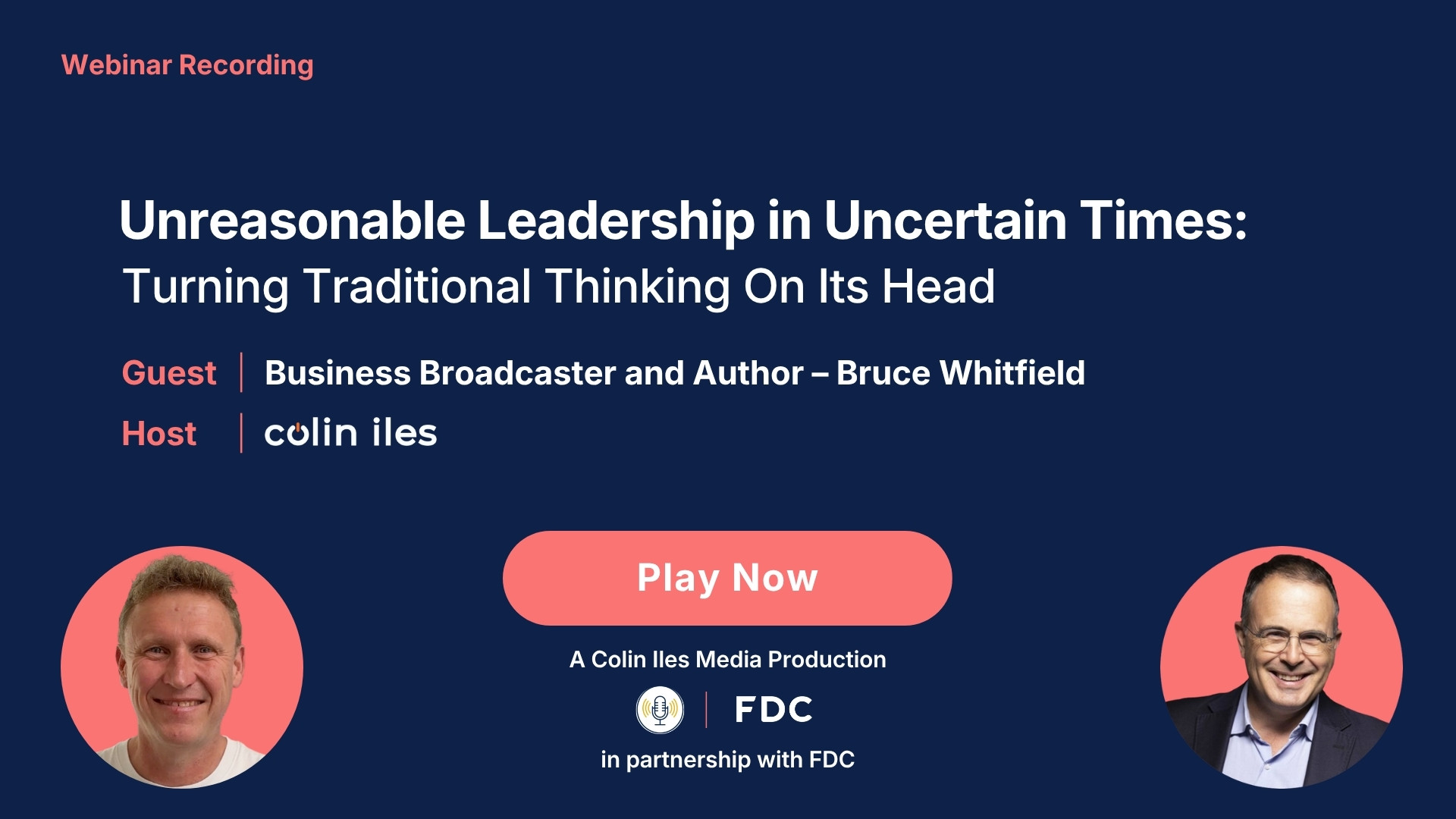 ▶ Watch the full recording
| In one line | Bruce Whitfield argues progress depends on unreasonable people, and that most large companies are playing not to lose. |
| Who should read this | CEOs and senior leaders in established organisations who know they need to change and are not sure how. |
| Key number | One South African bank's compliance department has grown from 800 people to 1,500 since Bruce spoke to it. |
| Bottom line | Be unreasonable about the goal, disciplined about the data, and never take a risk that can break you. |
| Read time | 9 min |
Bruce Whitfield did something like 50,000 interviews in 21 years of hosting The Money Show. I listened to a fair number of them on the drive to work. Of all the business presenters on air, he was the one I wanted to hear: the best informed, and the best at niggling a guest until something interesting came out.
Bruce is an award-winning business broadcaster, the author of four books including The Upside of Down, Genius and It's About Tyme, and the 2026 Best Inspirational Speaker at the UK Speaker Awards. He now advises and speaks to boardrooms and global audiences. He joined me on 24 November 2026 for the FDC Leadership Series to talk about the thread running through all of that work: unreasonable people. The FDC Leadership Series is made possible by FDC.
The unreasonable person: what Bruce means by it
Bruce's starting point is George Bernard Shaw's line that progress depends on the unreasonable man, updated a century on to the unreasonable person. Going back through 25 years of interviews and books, he found that for at least two thirds of that time he had been zoning in on exactly those people: "those who embrace change, those who embrace uncertainty and those who are able to navigate that uncertainty better than others."
It is not only founders. Great sportspeople, magicians, anyone who has done something exceptional share it: "they are deeply unreasonable in their expectations of their own abilities, in the work ethic that they employ." The ones who matter most also build teams around them that make them better.
His examples ran from Elon Musk, whose rockets, robotics, AI, tunnelling and solar businesses each make sense on Earth today while pointing at one deeply unreasonable goal, Mars, to Richard Branson, stuck on an island with no seats home, chartering a plane and selling seats to strangers going the same way. Then, in the 1980s, he took on British Airways.
Closer to home there is Adrian Gore of Discovery. He tried the United States twenty years ago, lost money and had the sense to retreat. He then went into the UK by buying Prudential's health business and turning it into Vitality, which now covers two million people with private health insurance there. Bruce's reading of the tea leaves is that he is ready to have another go at America.
Can you train an unreasonable leader?
Bruce does not think you can create another Coenraad Jonker or Steve Jobs, any more than you can create another Usain Bolt. You can train plenty of fast runners, and only a tiny fraction will ever go faster than Bolt. He pointed to Matthew Syed's book Bounce, which makes the case that very few people are born to succeed, and that time and practice do most of the work.
What organisations can do is encourage the thinking. Bruce runs what he calls the one thing intervention from the stage: "If there was one thing you could do if you were CEO for just half an hour, what would you do?" People write it down, anonymously, and he then puts the chief executive on stage to answer them. The same five or so themes come up every time, and getting rid of committees is usually one of them.
"It's fun to see chief executives tap dancing in real time to the challenges that their own people put to them in a safe space," he said. Doing it at all is a courageous, unreasonable act for a CEO.
Playing to win versus playing not to lose: why incumbents struggle
I pushed back here. South Africa's incumbent banks had the balance sheets and the technologists, and they did nothing to stop Capitec or TymeBank. Do they not see it, or do they not care?
Bruce's answer: they do not know how. He described speaking in a bank's compliance department about eight years ago, when it had 800 people in it. He has been told it now has 1,500. "Compliance has become the watchword."
Capitec, by contrast, began as an amalgamation of small-town moneylenders and "had no right to exist." Its founders had an unreasonable view and built South Africa's biggest retail bank. Bruce made the same point on a panel at the Singapore FinTech Festival, where consultants were describing how they reimagine banking by reverse engineering technology into Southeast Asian banks. The challengers coming through the ranks, he told them, "are playing to win, and at the moment you're playing to not lose."
When the most unreasonable decision is to do nothing
A listener asked whether this was all survivorship bias. Tim Cook has done fine at Apple, Satya Nadella has done fine at Microsoft, and neither is a wild founder.
Bruce agreed, and turned it round. "Sometimes the most unreasonable thing you can do if you are a Satya Nadella or a Tim Cook is to not do things." Leave the trailblazers to spend the money and make the mistakes, then adopt what works when you need it, while you focus on the core business. "Doing nothing is a decision too if you are at risk of losing focus on your core business."
Nvidia and Jensen Huang: unreasonable is not the same as ungoverned
The day before we spoke, Nvidia's board had voted unanimously to reinstate Jensen Huang as chief executive, less than two weeks after accepting his resignation. I asked Bruce whether a company that dependent on one person is an argument for less governance, or a warning.
A warning. What the episode puts in plain sight, he said, is that "when power is too concentrated at the top and too dependent on a single unreasonable leader... then you're hugely at risk." It makes no difference whether the leader is lost to a plane crash or to his own behaviour.
And he drew a line I think every board should hear: "Unreasonable isn't breaking the law. Unreasonable isn't being an autocrat."
His contrast is Tyme Group, the business whose story he told in It's About Tyme. If founder Coenraad Jonker, "who flies far too much for his own good", ended up "on the wrong side of a runway one day", there are two or three people who could step in. The transition would be hard and investors would need time, but the succession plan is visible. Bruce did not think that was as clear at Nvidia, and he noted the rapturous applause Huang got when he walked back into the building. "You wouldn't get that in a reasonable business."
Purpose before profit: how Tyme was built
Asked what actually drives someone like Jonker, Bruce gave one word: purpose. Jonker trained as a lawyer, became chief executive of a corporate law firm at about 31, then went to learn business at GIBS in its first cohort. He was inspired by the economist Hernando de Soto's argument that no economy can lift itself without financial inclusion.
About 24% of people in the world still cannot get a bank account. "If you're a reasonable banker... there is no way that you are going to offer banking services to people who live on three or four dollars a day." The unreasonable answer was cloud computing, no branches and digital-first identity, which is how Tyme now serves more than ten million customers.
Risk, data and the difference between unreasonable and unhinged
Bruce does not romanticise risk, but he does not avoid it either. "Perhaps the biggest risk is to take no risk at all." Most sensible leaders who have built global businesses, he said, cap any single risk at about ten percent of the value of the business: "never take a risk that is going to break you."
Nor are unreasonable leaders driven by emotion. "The very best of them are incredibly data led." Funders want evidence of a plausible business case, and that is the check that separates "unhinged leaders rather than unreasonable leaders."
On planning, he paraphrased Eisenhower: plans are pointless, planning is critical. Think of the run since 2019: COVID, broken supply chains, inflation that was not transitory, rising rates, AI, tariffs, and then the closure of the Strait of Hormuz that nobody saw coming. He quoted Morgan Housel's Same as Ever: risk is what you don't see. The businesses that come through are the ones constantly talking to and adapting with their customers.
Leaving radio: Bruce's own unreasonable call
I asked Bruce about his own leap. He had what looked like the best job in South African business media, and walked away from it with young children at home.
It was not his first. In 2003, three years into MoneyWeb, he could have stayed and done well, and chose to change. On radio, the format grew from 20 minutes of business interviews to an hour, then to two hours. Eventually the fixed slot, the ad breaks and the traffic reports at the top of the hour became the constraint, while podcasting let him go after the best people in the world for as long as he liked.
What tipped it was complacency he could feel coming: "you start arriving a little later perhaps and you start taking more risks on air and you don't prepare quite as well as you should have." His question to himself was simple. "If not now, then when?"
Complacency, succession and why it is a team sport
Long tenure is not the problem in itself. Hendrik du Toit has run Ninety One since inception more than 30 years ago, and Adrian Gore has run Discovery for as long. Both, Bruce said, would admit there are people who could replace them, and both have made sure of it. That takes self-awareness, which is "absolutely critical in a leader who is going to be that demanding on their teams."
So is it a solo sport? "Absolutely not. It's an absolute team sport."
Is AI another Y2K?
Bruce's answer to the yes-or-no version: "In the short term, yes, and the long term, no." He is working on a podcast series about AI-native businesses leapfrogging into markets they could never have entered five years ago, and he has not made up his mind whether that ends well. Growing too fast without the hard knocks and the governance is the Icarus risk.
Can incumbent banks survive the challengers?
For now the challengers are focused on retail banking. They cannot yet compete in business banking, corporate banking or advisory work. But Bruce expects even today's challengers to be disintermediated, pointing to retailers building banking capability inside the store, such as the deal involving Shoprite and Investec.
Is unreasonable leadership only for the young?
No. Anne Boden started Starling Bank in her mid-fifties, and at 67 is building an AI-powered financial services business. Nubank started as a Brazilian challenger, now has about 120 million customers, has become one of the most valuable companies in Brazil, and has a licence to go into the United States. It has also invested in Tyme.
The FDC Leadership Series is made possible by FDC. If you want help building your presence and your pipeline on LinkedIn, talk to FDC. Bruce speaks to leadership teams and conferences around the world: if you would like to bring him in, reply to any of my emails and I will introduce you.
Supported by
FDC
FDC Leadership Series

Upcoming Virtual Event
15 Years of Forbes Africa: Women, Leadership and the Future of Media
Tuesday, 15 December 2026
With Renuka Methil, Forbes Africa
RegisterMore from The Backroom
- What the Springboks Measure That Business Doesn't
Bob Skinstad on Rassie Erasmus's battle stats, the bomb squad, and why most firms have an AI absorption problem, not a value problem.
- The New Rules of Leadership in an AI-Powered World
Bob Skinstad captained the Springboks, then stopped at 31 and started again at something he was not yet good at. On leadership, sport and AI.
- Everyone Can Now Build Their Own Shed
Colin Iles on what the Shed at Dulwich and Zappos teach about testing demand, why AI agents now let anyone build, and what happens when agents sell to agents.
- Why Kieno Kammies Left Radio at 47 to Build Innovation City
Kieno Kammies on leaving talk radio at 47, building Innovation City Cape Town through COVID, and why founders must find a market in the gap.
The Backroom
Get conversations with senior leaders delivered to your inbox.